
Magnetic Resonance Imaging (MRI)
The fastest and safest non-invasive way to get clear, detailed pictures of your foot and ankle condition.
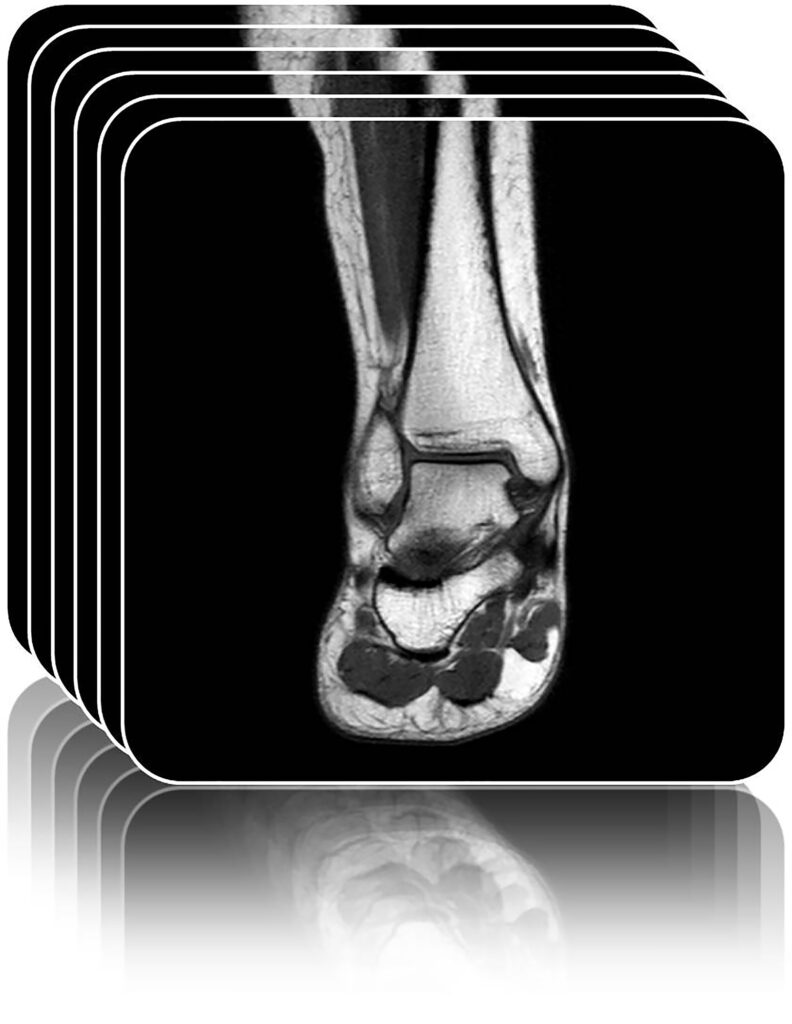
What You Need To Know About MRI
Here is how MRI works and why it plays such an important role in foot and ankle care.
Understanding Foot and Ankle MRI
Magnetic Resonance Imaging (MRI) is the fastest and safest non-invasive method to get the clearest pictures of your foot and ankle condition. Since their invention in the late 1970’s, MRI has grown to become an indispensable part of practice for podiatric and orthopedic physicians.
MRI allows us the ability to see inside the body and visualize a structure, determine the extent of injury, and provide focused treatment. MRI does this all without using X-rays. Instead, MRI uses a magnetic field that absorbs or deflects the electric charge given off by the cells themselves and creates a picture from that deflected charge.
MRI is particularly useful for evaluating soft tissue structures that X-rays cannot show clearly, including tendons, ligaments, cartilage, and nerves. It can also detect stress fractures, bone marrow changes, infections, and tumors that may not be visible on other imaging studies.
While MRI has universal applications, not everyone qualifies for its use. Those with brain aneurysm clips, metallic foreign bodies in the eye, recent surgery with orthopedic implants, pacemakers, or cochlear implants should not use MRI. Our technologists are trained to determine if MRI will be allowable for you, and your provider will discuss whether imaging is the right next step for your condition.
Our Open MRI Technology and Process
We use industry-leading Extremity OPEN MRI machines to offer advanced imaging to our patients. Our MRI machines are open, so you do not have to lie inside a tube. You comfortably sit in an attached chair and simply place your leg in the machine while the MRI takes its pictures.
Aside from being open, our machines are much quieter than traditional MRI systems, making the experience more comfortable for patients who may feel anxious about enclosed spaces or loud noises during imaging.
The MRI process typically takes around one hour. During the scan, it is important to stay still so the images come out clear and detailed. There is no recovery time afterward, and you can return to your normal activities right away.
All of our MRI scans are read by a board-certified musculoskeletal MRI radiologist, who provides a report within 24 hours. An appointment will be made with your doctor to review the MRI and discuss a treatment plan based on the findings, so you can move forward with a clear understanding of your condition and your options.
Locations Offering MRI Imaging
Find a convenient Artisan Foot and Ankle Specialists location offering on-site MRI imaging.





Get clear answers about your foot or ankle pain with advanced MRI imaging.
Don’t wait to find out what’s causing your pain. We’re here to help.